
How to Lead, Invest & Grow in a World Driven by Courage and AI
5 Voices Redefining Leadership, Market Discipline, Human-Centered AI & Career Growth for 2025
What do courageous founders, disciplined investors, ethical AI innovators, and people-first HR leaders have in common? They’re all responding to a world changing faster than human systems can adapt. In this week’s Scaling My Impact, five Top Voices unpack what it really takes to thrive in a landscape defined by uncertainty — from Raj Khera’s blueprint for courageous micro-actions that transform careers, to a powerhouse Inspired Money panel revealing how disciplined, data-driven investing outperforms emotional decisions during volatility.
You’ll also hear from Cory Warfield, José Joaquin Bitar Name, and Dr. Casey DeBruyn why AI’s evolution must remain human-centered, values-driven, and collaborative. And on Blue TV, Denise Murtha Bachmann breaks down the emotional reality of visibility — why creators hesitate to show their work, how self-doubt blocks opportunity, and what it takes to build a brand through authentic, consistent presence.
Whether you’re leading a team, making smarter financial moves, navigating the rise of AI, or learning to show up with confidence, these four conversations offer a grounded, human roadmap for thriving in a rapidly shifting world.
How Courage Creates Opportunity: Lessons from a Serial Entrepreneur Who Built His Career on “Yes”
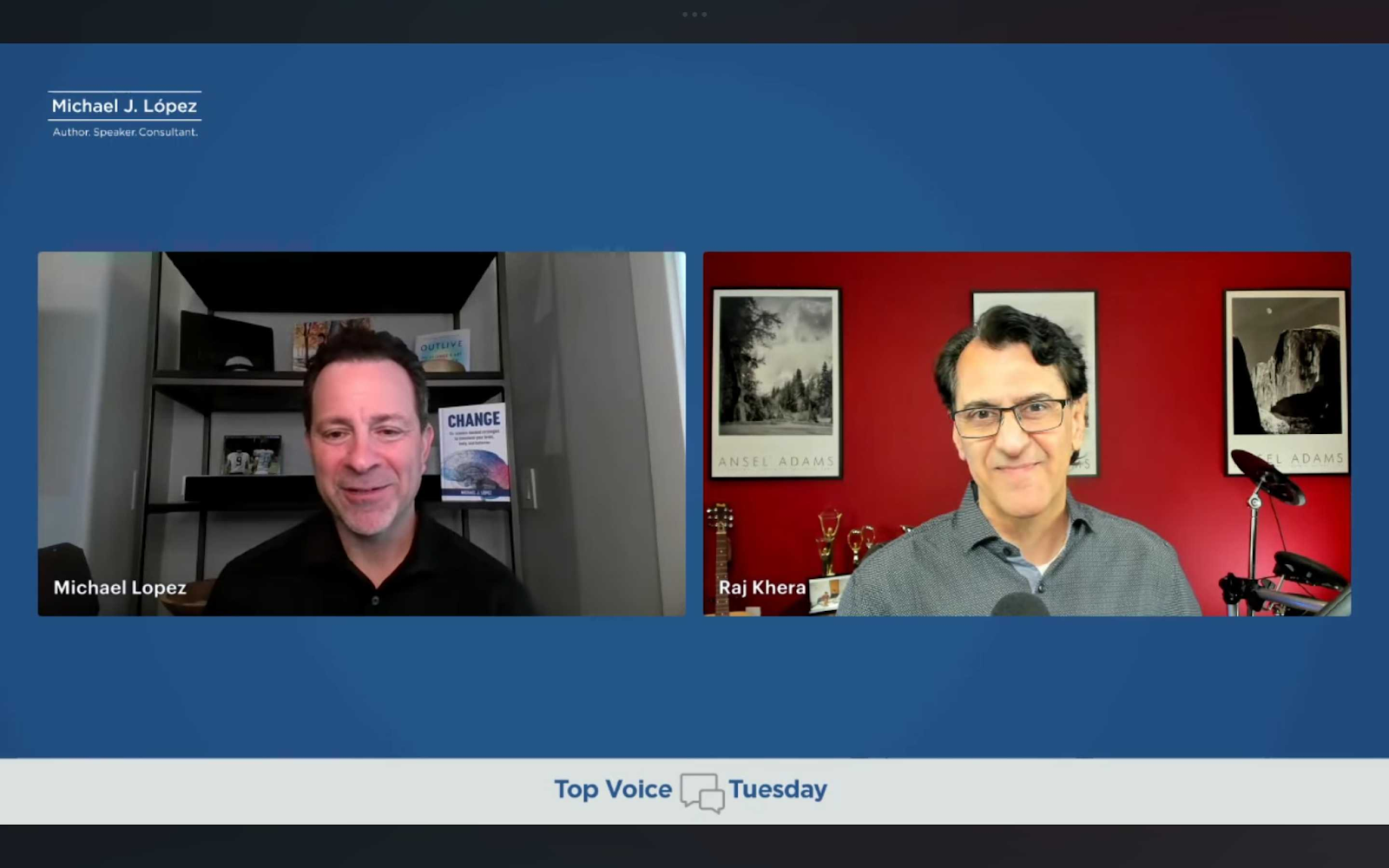
Some people wait for opportunities. Others create them with a single brave action. In this Top Voices Tuesday episode, Raj Khera, serial entrepreneur and founder of multiple acquired companies, sat down to explore a transformative idea:
Courage isn’t the absence of fear—it’s the decision to move anyway.
Hosted by Michael Lopez, this conversation walked through Raj’s evolution from a government engineer to a four-time founder, revealing how small acts of courage, mindset shifts, and long-term vision shape extraordinary careers.
If you’ve ever hesitated before taking a risk or felt held back by old beliefs, Raj’s journey offers a blueprint for moving forward.
Why Fear Holds Us Back (And Why Some People Move Anyway)
“Fear is rooted in what we learned growing up… and we spend our adulthood shaking those mindsets off.” — Raj Khera
Raj explained how our earliest messages—about money, ambition, and success—can quietly shape risk tolerance for decades.
Some hear “money doesn’t grow on trees,” which reinforces caution. Others hear “never let someone else control your paycheck,” which encourages entrepreneurship.
Recognizing the source of your fear is the first step to rewriting it.
This article explains how “risk-blindness” occurs because of the way our brains are wired — often leading people to miss or underestimate risks until they occur.
How to Build Confidence Through Small, Courageous Actions
“Start small. Smile. Say hello. It sounds simple, but those small steps build confidence.” — Raj Khera
Raj revealed a surprising truth: courage doesn’t begin with big risks. It begins with micro-moves:
- smiling at someone
- saying hello
- offering a simple encouragement
- sending a thank-you note
He shared that a handwritten thank-you note he wrote early in his career is what secured him a life-changing mentor—one who later helped him co-found and sell his first company.
A very recent review article which emphasizes the power of small, incremental changes (tiny habits) to foster long-term behavioral change and suggests these changes across domains (health, productivity, personal growth) can lead to sustainable transformation.
How to Stay Focused When Everything Is Falling Apart
“When you're backed against a wall, you compartmentalize… and focus on one thing at a time.” — Raj Khera
Raj shared a crisis moment: A spam-blocking service cut off his company’s email deliverability—effectively shutting down revenue—while he was solo-parenting his young kids.
His response?
- Compartmentalize
- Use the Pomodoro technique
- Block deep-work time
- Focus on single actions
- Move—physically and mentally
The result: The company recovered in days.
This recent review found that “time-structured Pomodoro interventions consistently improved focus, reduced mental fatigue, and enhanced sustained task performance, outperforming self-paced breaks.”

How to Think Long-Term Like a High-Impact Entrepreneur
“I review my bucket list every December. It’s not a New Year’s resolution—it’s my life list.” — Raj Khera
Raj introduced a powerful strategy: Reverse-engineering your future.
He encourages everyone—including new team members—to imagine their life 10 years from now. Then 5 years. Then 1 year. Then the steps they must take today.
This framework:
- aligns opportunities with vision
- removes pressure for instant success
- builds a culture of proactivity
MIT Sloan argues that for leaders and organizations to successfully drive innovation amid rapid change, they must be purpose-driven and long-term oriented.
3 Key Takeaways You Can Apply Today
1. Courage Begins With One Small Ask
“All I did was ask a question—and it changed the entire direction of my life.” — Raj Khera
A simple ask led Raj to an eight-year research fellowship and launched his career.
2. Movement Creates Motivation
“Movement makes you think better. It reduces anxiety and helps you process uncertainty.” — Raj Khera
Whether walking during interviews or pacing while negotiating, physical motion improves clarity.
3. Say Yes Before You Feel Ready
“Don’t be your own worst enemy. Just say yes.” — Raj Khera
Raj became a university board chair simply because he volunteered—despite being terrified.
Why Saying “Yes” More Often Builds the Future You Actually Want
Raj’s story is a reminder that the most transformative opportunities don’t begin with perfect plans—they begin with a single yes. Courage compounds. Momentum builds. Each small action creates a doorway to the next one. And over time, those doors shape the life and leadership path we step into.
Whether you’re navigating uncertainty, building a business, or simply trying to grow into your next chapter, Raj’s message stands strong:
Say yes a little more often. Move even when you feel unsure. Trust that clarity comes through action—not before it.
If you embrace courage in the small moments, the big moments will follow.
How to Put These Ideas Into Action
📺 Catch the full episode on-demand: The power of yes: How courage opens the right door with Raj Khera
- In LinkedIn: The Power of Yes: How Courage Opens the Right Door
Connect with speakers:
- Connect With Raj Khera to learn more about leadership, courage, content strategy, and entrepreneurial growth.
Join the next episode of Top Voice Tuesday with Tiffany A. Yu on December 9 at 12:00 PM EST on LinkedIn Live. Register here!
📬 Get the most of the insights from our featured Top Voices in this episode!
- Connect with Michael Lopez to explore global conversations on leadership, innovation, and community building through Top Voices Tuesday.
- Learn from Michael’s latest thinking on change and transformation, along with current topics discussed on the Top Voice Tuesday Podcast and subscribe.
3 Steps to Build an Investment Strategy That Survives Volatility
Market volatility isn’t new—but the last few years introduced levels of uncertainty that push even seasoned investors out of their comfort zones. This week on Inspired Money, host Andy Wang assembled a powerhouse panel: Katie Stockton, CMT, Michael Taylor, Seth Cogswell , and Gary Brode —leaders whose perspectives span technical analysis, healthcare, quantitative strategy, and deep-value investing.
Rather than predicting the next market turn, they focused on what actually matters: discipline, process, data, and the ability to separate noise from signal.
This conversation revealed not just what’s happening in the markets, but how investors can think more clearly—especially when the world feels unstable.
Why Market Volatility Feels Worse Today (And What Most Investors Get Wrong)
“People often react to volatility emotionally. But markets have always moved in cycles—you need a system that outlasts the noise.” — Katie Stockton, CMT
Katie explained that today’s environment feels more chaotic not because the market is fundamentally different, but because investors have fewer filters for the noise.
Her disciplined technical approach helps investors focus on:
- trend confirmation
- momentum signals
- support and resistance levels
- key reversal zones
A recent 2024 study linking market volatility (including sudden spikes) to investor psychology and economic growth dynamics. It underscores how cognitive biases (herd mentality, loss aversion, etc.) can amplify volatility — which is a useful context for long-term investors.

How Disciplined Investors Avoid Emotional Pitfalls
“Your process matters more in volatility, not less. It’s how you avoid doing something dumb when things get loud.” — Michael Taylor
Mike emphasized that emotional mistakes—panic selling, fear buying, and reactionary shifts—cause far more damage than the volatility itself.
He noted that healthcare, in particular, experiences sentiment-driven swings that a disciplined investor can navigate with patience and structure.
Empower outlines practical ways investors can stay grounded during volatile periods.
Why Quantitative Clarity Helps You See Beyond the Noise
“Our job isn’t to predict—it’s to measure. Volatility creates both distortion and opportunity depending on how well you quantify it.” — Seth Cogswell
Seth explained that quantitative strategy removes emotion and focuses on objective signals.
His method helps identify:
- quality factors
- statistical mispricings
- volatility clusters
- stable earnings drivers
- cross-factor opportunities
Investopedia provides a clear, accessible breakdown of what volatility actually means and how it’s measured.
What Volatility Reveals About Hidden Market Opportunities
“Volatility tells you where the story is changing. That’s where we uncover mispriced assets.” — Gary Brode
Gary explained that dislocations often signal narrative shifts—places where the market hasn’t fully adjusted. That’s where sharp fundamental research uncovers opportunities.
Edelman Financial Engines outlines how to use volatility to rebalance and pursue new market openings.

What Happens When You Stay Steady in Volatile Markets
Volatility unnerves investors because it feels unpredictable. But as this panel made clear, it also reveals the strongest signals—if you know where to look. The investors who win long-term aren’t the ones who avoid volatility. They’re the ones who respond intelligently to it.
As Andy summarized:
“Volatility is uncomfortable, but it’s also informative. It tells you where to look, not what to fear.”
How to Strengthen Your Investment Strategy From Here
🎧 Catch the full episode on-demand and share it with someone who needs to hear it.
- In YouTube: Market Volatility Doesn't Phase Them—Here's Why
🎙️ Listen to past episodes of Inspired Money Podcast in different platforms here: Inspired Money with Andy Wang
✉️ Subscribe to Andy's email newsletter for investment insights: https://www.runnymede.com/newsletter
- Andy Wang – Explore more insights, financial clarity, and new opportunities through the Inspired Money podcast.
- Company Website: Runnymede Capital Management https://www.runnymede.com/ LinkedIn:
- Katie Stockton, CMT – Dive deeper into technical market analysis, trend research, and disciplined investing strategies through Fairlead Strategies.
- Company Website: Fairlead Strategies
- Michael Taylor – Learn more about healthcare investing, ETF strategy, and macro healthcare trends through Simplify’s PINK ETF.
- Company Website: Simplify ETFs
- Seth Cogswell – Explore quantitative-driven investing, market research, and quality-focused portfolio design with Running Oak Capital.
- Company Website: Running Oak Capital
- Gary Brode – Access independent research, stock ideas, and deep-value market insights from Deep Knowledge Investing.
- Company Website: Deep Knowledge Investing

Stop sending generic holiday messages and start communicating with intention. The truth? Hiighly personalized cold emails can boost reply rates by up to 142% compared with generic outreach. (SmartleadAI)
But as Denise shared on Blue TV, rushing through holiday outreach leads to generic messages, quiet inboxes, and relationships that feel more distant than before.
Here’s the shift: Holiday outreach isn’t a promotion strategy. It’s a moment of presence, warmth, and gratitude—a relationship project that deepens trust. And when you treat it that way, LinkedIn becomes one of the most powerful spaces to reconnect authentically and carry meaningful momentum into 2026.
The Breakthrough: Outreach Is a Gift, Not a Pitch
Denise opened the episode with a mindset reframe that changed the entire conversation:
“Give the gift of you. Outreach during the holidays isn’t a checklist—it’s presence, kindness, and genuine connection.”
This shift removes the pressure to perform or persuade and replaces it with something far more effective: warmth, curiosity, and recognition.
How to Structure Holiday Outreach That Actually Works

How to Structure Holiday Outreach That Actually Works
1. Lead with Warmth and Kindness
A holiday message should feel human, not promotional. A warm opening builds connection instantly.
Example: “Thinking of you this season—hope it’s been a meaningful year.”
2. Reflect on Their Year, Not Yours
Referencing something they did shows genuine attention and care. This instantly makes your message feel personal.
Example: Mention a post they shared or a milestone they hit.
3. Express Genuine Gratitude or Recognition
Holiday outreach is the perfect moment to acknowledge someone’s impact. Gratitude strengthens trust and deepens relationships.
Example: “You’ve done incredible work this year—cheering you on into 2026.”
4. Invite Reconnection—Without Pressure
A light, open-ended invitation encourages natural conversation rather than obligation. This keeps the tone supportive and human.
Example: “If you ever want to brainstorm ideas for 2026, I’m always here—no pressure at all.”
Denise reframed holiday outreach as part of a relational marketing culture—an approach rooted in empathy, listening, and genuine care. “People want an experience—not a pitch.”
How to Use Holiday Outreach to Reengage Dormant LinkedIn Connections One of Denise’s most powerful insights was how to revive LinkedIn relationships when engagement drops or contacts have gone silent — using holiday outreach as a warm, strategic reentry point instead of a sales nudge.
Treat dormant connections like relationship pauses, not rejections:
- Reflect on their recent LinkedIn activity before reaching out
- Personalize your holiday message to show genuine attention
- Restart the conversation with a soft, curiosity-driven question
This simple shift removes the pressure, boosts LinkedIn engagement, and turns year-end outreach into authentic relationship building.
Action Items for This Week
Message someone you haven’t spoken to in a while using a warm, personalized greeting that reflects their year and invites conversation.
Before sending any holiday message, read the person’s profile and recent activities to tailor your outreach.
Ask a reflective question that encourages authentic dialogue, such as “What’s one thing you’re proud of this year?” or “How are you preparing for 2026?”
Try sending a voice note. Denise highlighted this as one of the most effective ways to bring warmth, tone, and human connection into holiday outreach. It stands out instantly in a season crowded with text.
Replay + Resources
📺 Watch the Full Replay of This Week’s Blue TV Episode: [On LinkedIn] [On YouTube]
Catch the next episode of Blue TV on December 3 at 11:00 AM EST with LinkedIn Top Voice Denise Murtha Bachmann. Stay tuned for more strategies to strengthen your presence, deepen your relationships, and elevate your LinkedIn impact.
🔷Get the best insights from our featured Top Voices delivered each week.
🔷Company Website: Sellovatorz
🔷 Book a 1:1 Sales Strategy Call with Denise → [Scheduling Link]
What Smart Innovators Do When AI Evolves Faster Than Society
AI is accelerating faster than human systems can adapt — reshaping work, identity, creativity, and ethical responsibility. In this episode of AI Zombies, host Nick Larson brought together three voices who live at the edge of that transformation:
- Cory Warfield — Futurist & ethical AI advocate
- José Joaquin Bitar Name — Founder, TUOM
- Dr. Casey DeBruyn — Expert in AI psychology & human behavior
Their message was clear: AI is not replacing humans — it is forcing us to rethink who we are, how we create, and how we govern intelligence.
Why AI’s Speed Outpaces Human Systems — And What It Reveals
“AI never gets tired, never loses focus — but humans do. We need new ways to work with it, not against it.” — Cory Warfield
Cory explained how AI’s exponential growth exposes structural weaknesses in:
- regulation
- ethics oversight
- creative industries
- labor markets
This gap isn’t just technical — it’s deeply human, and it shows why human-centered AI design and ethics are critical now more than ever.
The concept of Human‑Centered AI (HCAI) argues for designing AI systems that prioritize human values, collaboration, and well-being over automation alone.

How to Preserve Human Values When Building with AI
“AI reflects what you feed it. If you want humanity in AI, you need humanity in the input.” — Dr. Casey DeBruyn
Dr. Casey DeBruyn emphasized that AI sys and without intentional human-centered design, those biases become amplified at scale.
Human-centered AI frameworks encourage designers to embed ethics, fairness, transparency, and respect for diversity. Such frameworks help ensure AI enhances human capabilities instead of undermining them.
Why Entrepreneurs Should Use AI as a Lever — Not a Replacement
“AI isn’t here to replace people — it’s here to level the playing field for those who embrace it.” — José Joaquin Bitar Name
José described how AI unlocks unprecedented leverage: automation, scalability, rapid creative outputunity — especially for small teams, creators, and underrepresented voices.
 3 Critical Takeaways to Keep in Mind
- AI Advances Are Tool Shifts — Human Values Must Anchor Them
“If you’re standing still, AI is already ahead of you.” — Cory Warfield
Let AI accelerate tasks — but let humanity define the mission.
- Ethical & Human-Centered Design Prevents Bias From Scaling
Ethics and inclusion aren’t extras — they’re essential to trust, safety, and long-term viability.
- Real Innovation Happens Where AI and Human Creativity Meet
“AI gives uoose to use it consciously.” — José Joaquin Bitar Name
AI can multiply what we already do — but it cannot replace what only humans bring: empathy, values, imagination, and judgment.
Final Reflection
“AI isn’t just changing technology — it’s changing identity. The real question is who we choose to become.” — Cory Warfield
AI offers power. But it’s human intention, ethics, and wisdom that shape whether that power builds or destroys.
📺 Watch the Full Episode of SZ 203: AI Zombies Ft Cory Warfield
- In LinkedIn: SZ 203: AI Zombies Ft Cory Warfield
Connect with the Speakers
- Nick Larson – Explore Nick’s insights on emerging technology, leadership, and the future of AI-driven media
- Cory Warfield – Follow Cory for grounded futurism, ethical AI frameworks, and practical ways creators and companies can use AI responsibly.
- José Joaquin Bitar Name – Learn more from José on human-centered innovation, technology for empowerment, and the next generation of digital ecosystems
- Dr. Casey DeBruyn – Connect with Dr. Casey for insights at the intersection of human behavior, AI ethics, and responsible system design.
How to Build a Career You’re Proud Of: Lessons from HR Leader Pamela Nakawooya
In this week’s edition of The People Behind the Posts, host Jose Kiggundu sat down with Pamella Nakawooya, an HR professional whose work focuses on empowering individuals to grow confidently, communicate clearly, and show up fully in their careers. From the realities of HR decision-making to the emotional challenges employees face behind the scenes, Pamela shared heartfelt and practical wisdom rooted in real workplace experiences.
Her insights remind us that success isn’t accidental — it’s learned, practiced, and strengthened through clarity, relationships, and resilience.
Here are 4 Lessons Learned from Pamela’s powerful conversation:
1. How to Stand Out Professionally When Everyone Has the Same Skills
“Soft skills carry you further than you think. Your attitude, communication, and reliability set you apart.”
Pamela emphasized that while education helps you enter the professional world, behavior is what helps you rise. HR sees your consistency, how you treat others, and how you carry yourself more than you realize.
She noted that professionals who communicate clearly, take initiative, and remain teachable tend to outperform those who rely solely on technical skill.
This is especially true in early-career roles, where potential and character matter even more than experience.

2. Why Building Healthy Workplace Relationships Speeds Up Your Growth
“Relationships shape opportunities. Sometimes less productive people rise because they mastered visibility.”
Pamela was honest: career advancement is not purely merit-based. People rise because of relationships, visibility, and reputation.
She explained that HR sees employees who are not necessarily the most skilled — but who know how to collaborate, show up confidently, and build trust with decision-makers.
Those who engage in healthy networking often gain access to opportunities long before they’re publicly posted.
McKinsey research shows that sponsorship and visibility dramatically increase the likelihood of promotion — especially for underrepresented talent.
3. How to Use Feedback as Fuel for Your Development
“Feedback isn’t an attack — it reveals your blind spots. When I embraced feedback, my career changed.”
Pamela shared that many employees avoid feedback because they feel judged or insecure. But the people who grow fastest are the ones who:
- Ask for feedback regularly
- Use it to improve their communication
- Apply it consistently
- Document their progress
Feedback becomes a form of career acceleration when you stop taking it personally.
Gallup reports that employees who actively seek coaching and feedback develop confidence faster and achieve higher performance outcomes.
4. How to Protect Yourself from Burnout Through Clear Boundaries
“Burnout is real — and it’s not only medical. Sometimes the body breaks down because the pressure is too much.”
Pamela spoke openly about the rising pressures in today’s workplaces — long hours, unclear expectations, emotional labor, and constant digital connection. She explained that burnout is a shared responsibility:
✔ Leaders must clarify roles and create psychologically safe environments.
✔ Employees must set boundaries, speak up, and leave toxic environments when necessary.
The World Health Organization classifies burnout as an occupational phenomenon caused by chronic workplace stress.
What To Do Next: Build the Career That Aligns With Your Values
Pamela invites professionals to reflect deeply on their strengths, be intentional with their visibility, and take charge of their mental and emotional well-being.
Your career growth doesn’t happen by chance — it happens by choice.
Whether you’re starting out, restarting, or leveling up, Pamela’s insights offer a roadmap for clarity, confidence, and consistency.
📺 Watch the Full Episode of ‘The people behind the posts,’ conversation with Pamela Nakawooya HR
🤝🏻Connect With the Host & Guest
- Follow Pamela Nakawooya for insights on intentional career growth, HR reality, personal development, and her upcoming 2026 Momentum Hub.
- Connect with Jose Kiggundu on LinkedIn for weekly conversations that highlight the humans behind the content—stories of resilience, leadership, mindset, and authentic growth.