
Top 5 Editions of Scaling My Impact That Stirred 2025
Before Christmas became commercialized, it marked a pause — a moment rooted in reflection, renewal, and shared humanity. By the 4th century, it was observed not as a productivity milestone, but as a time to re-orient values before moving forward.
That framing still matters.
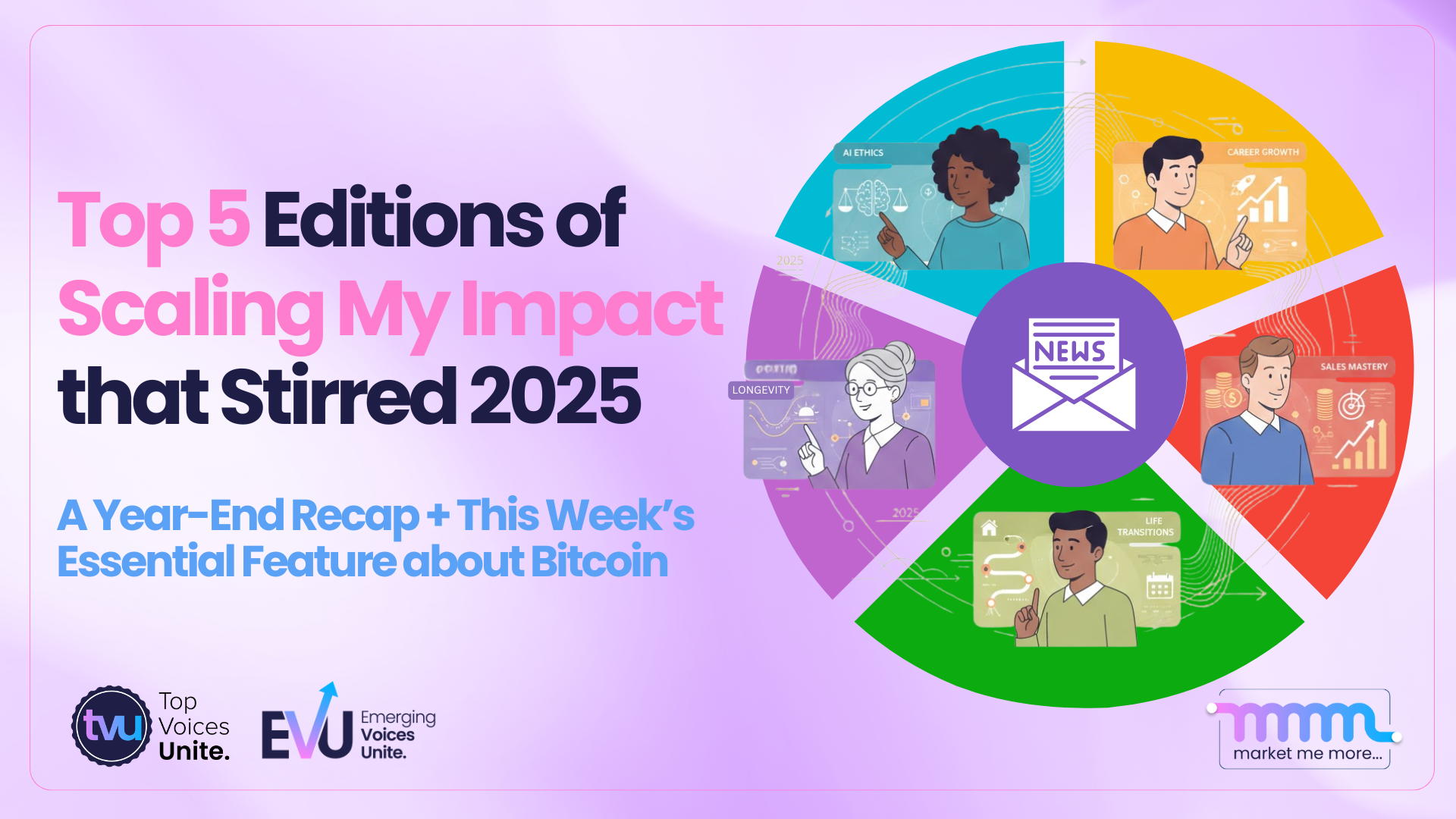
After publishing 47 newsletter editions of Scaling My Impact this year, five weekly editions stood out — not because they shouted the loudest, but because they gathered multiple conversations from different events that challenged how leaders think about strategy, identity, health, growth, and change.
As we move past Christmas Day and toward year-end, this recap reflects on 5 weekly conversations (and the voices behind them) that stirred our Top Voices Unite community in 2025.
Top 1: Future Leadership, Conscious Tech & Purposeful Strategy

The 28th Edition’s Featured Voices
- Denise Murtha Bachmann on Blue TV
- Andy Wang and his expert panel (Andrew Behar, Jennifer N. Coombs, Marilyn Waite, and Prof. Ioannis Ioannou) on Inspired Money
- Nick Larson and Cory Warfield on AI Zombies
- Nikki Estes on Voices of the Week
This edition brought together conversations exploring how leadership must evolve as technology accelerates faster than governance.
Why it stirred conversation?
- AI adoption is accelerating faster than governance
- Leaders are delegating decisions without shared context
- Trust gaps are widening across generations
💡Relevant Insight
Research from MIT Sloan shows organizations that over-rely on automated decision systems face lower employee trust and higher ethical risk, especially in multigenerational teams.
📌 What lingered?
Efficiency can scale action — but not judgment.
📰 Read the full 28th edition here:
Top Voices Weekly: Future Leadership, Conscious Tech & Purposeful Strategy
Top 2: Career Growth, Leadership & Life Changes

The 8th Edition’s Featured Voices
- Michael Lopez & Russ Riendeau on Top Voice Tuesday
- Bobby Umar, Marie Zimenoff, Pamela Dukes, & Nikki Estes on Women Who Lead and Create Impact - TLB Club Monthly Livestream
This edition explored career shifts, identity changes, and leadership recalibration — not as moments of failure, but as moments of growth.
Why it resonated?
- Career paths are no longer linear
- Leadership identity is often disrupted before it’s rebuilt
- Many professionals are navigating change without language for it
💡Supporting Insight
LinkedIn’s Workforce data shows professionals now change roles nearly twice as often as they did a decade ago.
📌 What lingered?
Career growth isn’t always upward. Sometimes it’s inward before it moves forward.
📰 Read the full 8th edition here:
This Week’s Power-Packed Events: Career Growth, Leadership, and Life Changes
Top 3: How to Navigate Life’s Biggest Transitions

The 44th Edition’s Featured Voices
- Andy Wang & his expert panel (Dr. Preston D. Cherry, Mariko Gordon, Jackie Cummings Koski, and Jacqueline “JaQ” Campbell) on Inspired Money
- Michael Lopez & David LaCombe on Top Voice Tuesday
- Denise Murtha Bachmann & Robert Jaeger on Blue TV
- Jose Kiggundu & Henry Ezeribe on People Behind the Posts
This edition brought together conversations about personal and professional transitions that don’t come with playbooks.
Why it stirred discussion?
- Leaders are rarely trained for emotional disruption
- Transitions affect decision-making long before outcomes are visible
- Many changes happen quietly — without recognition
💡Relevant Insight
Harvard Business Review reports that leaders navigating major transitions without support face significantly higher burnout risk within the first year.
📌 What lingered?
Change doesn’t need certainty to begin — it needs support and reflection.
📰 Read the full 44th edition here:
How to Navigate Life's Biggest Transitions
Top 4: The Future of Living Well

The 37th Edition’s Featured Voices
Ageless Evolution Longevity Summit 2025 with hosts Nick Larson and expert speakers Shannon Adams, Piotr Zajac, Dr. Hillary Lin, Dr. Thomas Santucci, Carelle Woerz, Dr. Anastasia Chemeritskaya, Lisa Lambie, Max Marchione, Dr. Daniel Kraft, Dr. Wei-Wu He, Peter Crone, Dr. Jonathan Scheiman, Dr. David Furman, Dr. Nuno Martins, Mark Victor Hansen, Crystal Hansen, Dr. William Kapp, Dr. Arbella Sarkis, Dr. Aubrey de Grey, Dr. Harris Masket, Dr. Ronjon Nag, April Rose Mora, Dr. Celia Remy M.D, José Joaquín Bitar Name, Frank Pezzullo, Dr. Niko Dimitriadis, Syama Bunten, Dr. Steve Garan, Antonio Alba, Mark Cofano, Dr. Sheena Menezes, and Dr. Ashley Zehnder.
This edition reframed longevity as a leadership and societal issue — not a wellness trend.
Why it stirred debate?
- Hustle culture still dominates leadership norms
- Preventive health is undervalued in performance planning
- Longevity is often discussed without emotional context
💡Relevant Insight
A majority of primary care visits are linked to stress-related conditions, according to medical research cited by the American Psychological Association (APA).
📌 What lingered?
Living well isn’t a luxury — it’s a leadership responsibility.
📰 Read the full 37th edition here:
The Future of Living Well: Inside the Ageless Evolution Longevity Summit 2025
Top 5: From Inbound Leads to Sales Mastery

The 5th Edition’s Featured Voices
- Nikki Estes, Ash K, & the Market Me More Team
- Denise Murtha Bachmann & Anna Rooney on Blue TV
- Michael Lopez & Craig Leach on Top Voice Tuesday
- Denise Murtha Bachmann & Cory Warfield on Live with Top Voices Unite
This edition focused on the shift from chasing leads to building repeatable, trust-based growth systems.
Why it resonated?
- Inbound doesn’t guarantee conversion
- Sales is still misunderstood as persuasion, not service
- Consistency outperforms volume
💡Relevant Insight
The Project Management Institute reports organizations with mature systems see 92% higher success rates than those relying on ad-hoc execution.
📌 What lingered?
Growth compounds when systems replace guesswork.
📰 Read the full 5th edition here:
From Inbound Leads to Sales Mastery: Key Business Growth Insights from This Week’s Events
The Thread That Connected the Top Five Editions
Although each newsletter edition featured different events and voices, they converged on one truth:
Progress in 2025 came from clarity — not intensity.
Across leadership, health, finance, and visibility:
- Presence outperformed polish
- Judgment outperformed speed
- Systems outperformed hustle
============================================================
Bitcoin’s Super Cycle, Tokenized Markets, and the Next Global Supply Shock
Despite over a decade of headlines, Bitcoin remains widely misunderstood—treated as speculative noise rather than a maturing financial system with predictable cycles.
That misunderstanding has consequences. Investors chase headlines, miss timing, and overlook structural shifts happening quietly beneath the market: capital migration, regulatory realignment, and a looming supply shock driven by adoption—not hype.
In this episode of Crypto Zombies, hosts Nick Larson, Hooman Khalili, Chris Kelly, and Bryn Nguyen sat down with Michael Terpin to unpack Bitcoin’s super-cycle thesis, the mechanics behind market timing, and how tokenization could quietly dismantle legacy financial plumbing.

Puerto Rico, Capital Migration, and Compounding Without Friction
Michael opened with a clear explanation of why Puerto Rico has become a magnet for crypto capital—not ideology, but arithmetic.
Once investors qualify under Act 60, both short- and long-term capital gains on crypto are taxed at zero, allowing gains to compound without federal or local drag.
As Michael explained:
“Once you qualify as being a bona fide resident under this program… you pay zero to the IRS and zero to the Puerto Rico government on your short-term and long-term capital gains.”
Hundreds of crypto and digital-asset investors have relocated to Puerto Rico under Act 60, forming unusually dense investor networks that accelerate deal flow, mentorship, and venture formation
📊 Context: Capital clustering is not unique to crypto. Stanford research shows financial hubs form when tax efficiency, social proximity, and liquidity converge—Puerto Rico now checks all three boxes.
Bitcoin’s Four Seasons: Why Cycles Still Matter
Rather than price prediction, Michael framed Bitcoin through repeatable structure.
Each halving initiates a four-year rhythm—spring, summer, fall, winter—driven by miner economics, supply restriction, and investor psychology.
He summarized the pattern plainly:
“As long as the amount of new Bitcoin purchased exceeds the amount of new Bitcoin mined, the price has to go up. It’s simple supply and demand.”
Historical context reinforces the claim:
- Post-2012 halving: ~30× peak
- Post-2016 halving: ~10× peak
- Post-2020 halving: ~8× peak
Diminishing returns, yes—but still materially outperforming most asset classes during peak phases.
Tokenization: The Quiet Threat to Financial Middlemen
A key shift in the conversation came when Chris raised the SEC’s recent no-action guidance on tokenized securities.
Michael’s response cut through the noise: tokenization isn’t about crypto speculation—it’s about efficiency.
He questioned the necessity of legacy intermediaries outright:
“Why do we even need the DTCC? … They’re rent-seekers that sit between the trading public and the companies.”
He outlined a future where companies issue shares directly, globally, with programmable compliance and transparent shareholder data—features legacy systems struggle to provide.
📊 Stat: Boston Consulting Group estimates tokenized assets could reach $16 trillion in value by 2030, primarily from equities, funds, and real-world assets—not cryptocurrencies.
Bitcoin vs. Altcoins: Risk, Recovery, and Error Tolerance
Nick pressed on concentration risk and whale influence. Michael’s answer emphasized resilience over returns.
Bitcoin, he argued, tolerates mistakes better than any altcoin sector.
“You can make a lot of mistakes in Bitcoin that can be recovered. Not so much with alts if you miss your top or pick the wrong sector.”
While altcoin cycles can deliver explosive gains, they demand constant monitoring, precise exits, and deep sector knowledge. Bitcoin, by contrast, remains the most forgiving asset in the space.
Adoption, Scarcity, and the Supply Shock Thesis
Perhaps the most consequential insight came near the close.
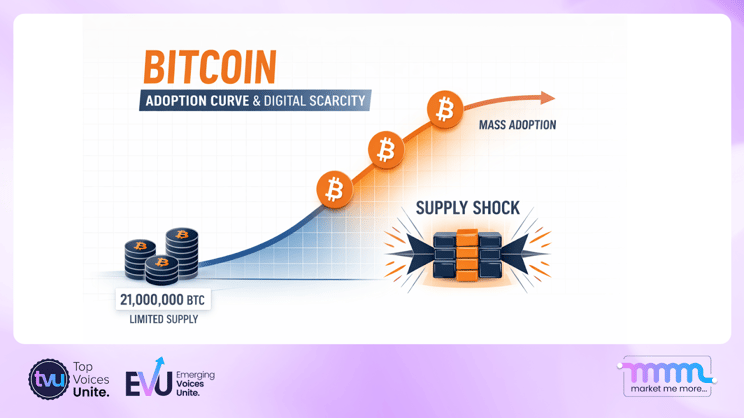
Global Bitcoin ownership still sits near 4%. Michael argued that even partial movement toward mainstream adoption would stress supply beyond precedent.
“If you go from 4% of the world owning Bitcoin to 20%, you have five times the demand—and it has to come from current holders.”
Unlike previous technologies, Bitcoin’s supply is capped. There is no equivalent of “printing more servers” or expanding bandwidth. Adoption growth does not increase supply—it concentrates it.
Key Takeaways
- Bitcoin’s market cycles remain structurally intact despite political and macro disruption
- Puerto Rico’s tax framework has materially reshaped crypto capital flows
- Tokenized securities threaten legacy settlement systems more than crypto markets
- Bitcoin remains the most error-tolerant asset in the digital space
- A modest rise in global adoption could trigger a historic supply shock
Replay + Resources
📺 Watch the Full Episode of “CZ 14: Breaking it down with THE Michael Terpin!”
- In YouTube
- In LinkedIn:
Join the next episode of Crypto Zombies on LinkedIn and YouTube Live! Stay tuned.
🤝 Connect with our Crypto Zombies guest speaker and hosts!
→ Personal Website: Bitcoin Supercycle
→ Company Website: Transform Ventures
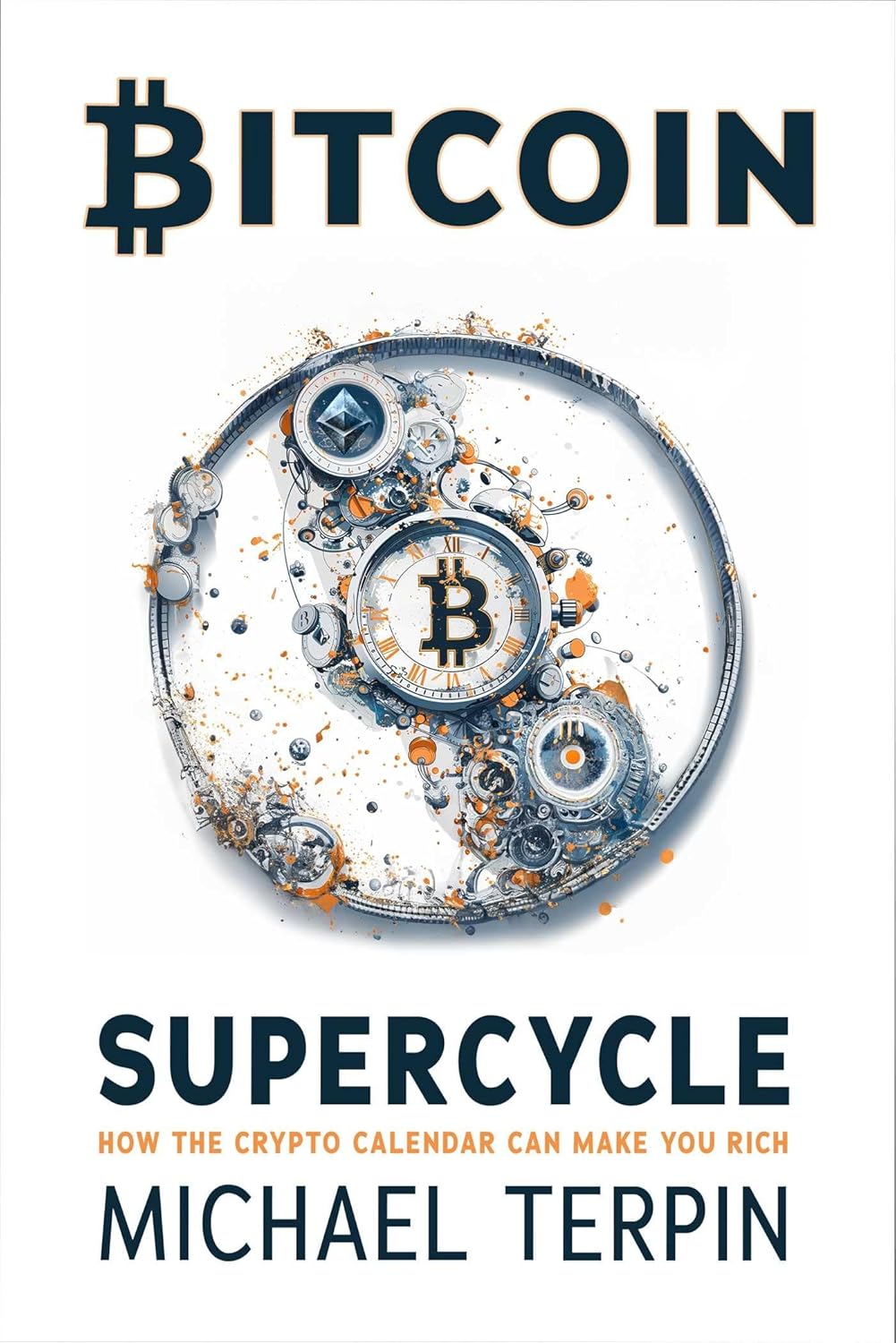
→ Purchase his book "Bitcoin Supercycle" on Amazon!



→ Personal Website: Hooman.tv
→ YouTube Channel: subscribe here!


→ Company Website: Silicon Zombies
→ YouTube Channel: subscribe here!
→ Need Advice? Book a 1:1 with Nick in Hubble!
→ Subscribe to Nick’s LinkedIn Newsletter: Brain Food
A Christmas-to-Year-End Reflection
Historically, Christmas invited reflection before renewal.
As 2025 closes, these five conversations (plus this week's crypto structure deep-dive) converge on one truth:
The voices that stirred 2025 weren't the loudest. They were the ones with the clearest understanding of structure.
Whether it's how careers evolve, how leadership systems work, how health compounds, how markets move, or how capital flows—the advantage in 2026 belongs to leaders who understand structure over intensity.
These conversations didn't offer shortcuts. They asked better questions. And as we move into the next chapter, that's your clearest roadmap forward.
============================================================Stay Connected to What Matters Most
Want more weekly strategy breakdowns like this?
- Subscribe to Scaling My Impact for weekly recaps and standout moments from our Top Voices Unite livestreams.
- Register for our weekly Market Me More newsletter to learn more from our Voices community, industry experts who teach on technology, sustainability, leadership, and go to market strategies, and how these affect the future of work.
Build your voice.
Expand your reach.