

June 27, 2026
10 mins to read




Have you ever walked away from a conversation thinking, I did not explain that well at all?
You knew exactly what you meant. The idea was clear in your head. But somewhere between the thought and the words, it fell apart. And the other person nodded politely and moved on.
For founders, that moment is not just awkward. It can be the difference between a yes and a slow fade.
The frustrating part is that most people assume it is a confidence problem, or a clarity problem. But what if the real issue is structural, .something you can actually fix?
That is exactly what this month's conversation gets into!
You have built something worth believing in. You know the problem you solve, the people you serve, and the impact you are after. But the moment you sit down to pitch it, post about it, or explain it to someone who matters, something gets lost. The vision is clear in your head. It just does not land the way you need it to. That is not a product problem or a confidence problem.
Founder Education Series is set on a monthly basis and this episode is the premiere one, it is a storytelling problem, and as host Nikki Estes put it directly during the session,
"Storytelling is not a soft skill anymore. It is a strategic skill."
That is the conviction behind everything Anubhav Srivastava has spent the last two and a half years building.
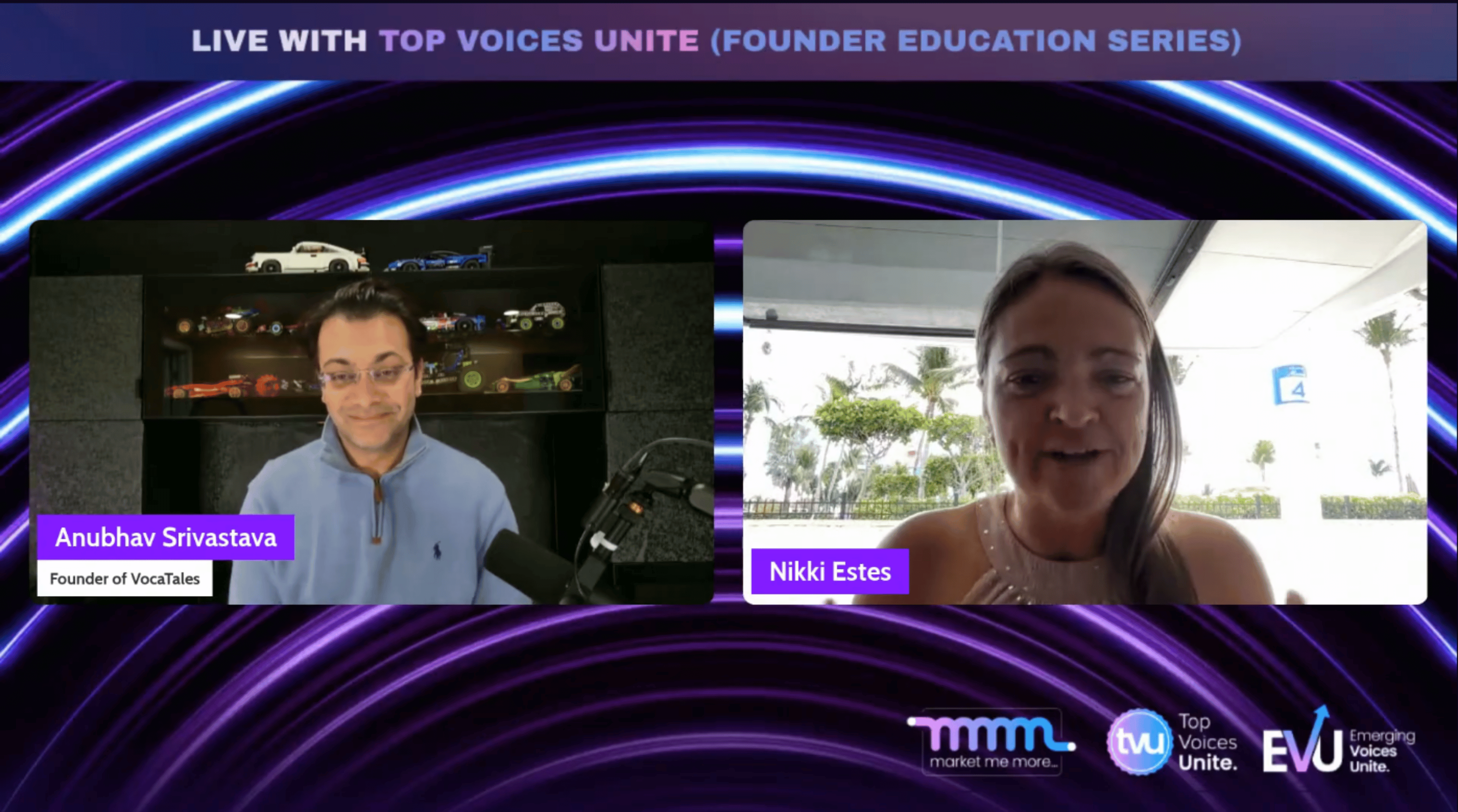
Anubhav, who has closed over a billion dollars in technology sales in his career, did not build VocaTales and UpTales because he lacked business experience. He built it because even with all that experience, he had never been formally taught what makes a story actually work.
When he started writing his own book, a professional editor sent it back asking "where is the story?", he realized the gap was real.
He enrolled in a six-month creative writing course at the University of Chicago in 2023 to understand the foundational elements (character, conflict, escalation, resolution) and what he found was that these same building blocks are what separate a forgettable founder pitch from one that moves people to act.
"Stories are important," Anubhav said. "They are differentiating. They are the ones that will help you connect at an emotional level. And that is something no AI can do."
For founders and leaders, the most actionable moment in the session came through Raj Nation, a storytelling coach and UpTales expert who works specifically with founders on their pitches.
His framework, QUE PASA, which stands for Problem, Approach, Solution, and Action, starts with what Anubhav called "the most sacrosanct rule of thumb that every founder needs to understand": know thy customer.
.png)
From there, each component of the pitch becomes a building block, assembled one by one until the full story clicks into place.
"The end result is your one-minute pitch, a comprehensive one-minute pitch, something that you would want to go out with and tell people,"
The same logic scales to investor decks, brand narratives, and LinkedIn content. It is, as he framed it, "a thinking tool", and thinking in structure is what turns expertise into influence.
Because here is what this session kept coming back to: the leaders who break through are not necessarily the loudest or the most prolific. They are the ones who have learned to make their story clear. As Nikki said,
"Those leaders that take advantage of using a system, a tool, a framework like this, they're not going to just be loud. They'll be clear."
In a world where AI can flood any feed with generated content, clarity built on lived experience and structured narrative is the one differentiator that cannot be replicated. For founders, aspiring leaders, and everyone in between who has something real to build, that is the skill worth investing in now.
Watch the full Founder Education Series Week 2 session: Scaling Your Vision Through Strategic Narrative, and hear it directly from the founders, storytelling experts, and platform builders behind it.
Why founder content marketing fails without narrative clarity — and the vision-to-voice shift that changes everything for founders, leaders, and aspiring ones.
Have we been here? You have built something real, and somehow, the world has not caught up to it yet.
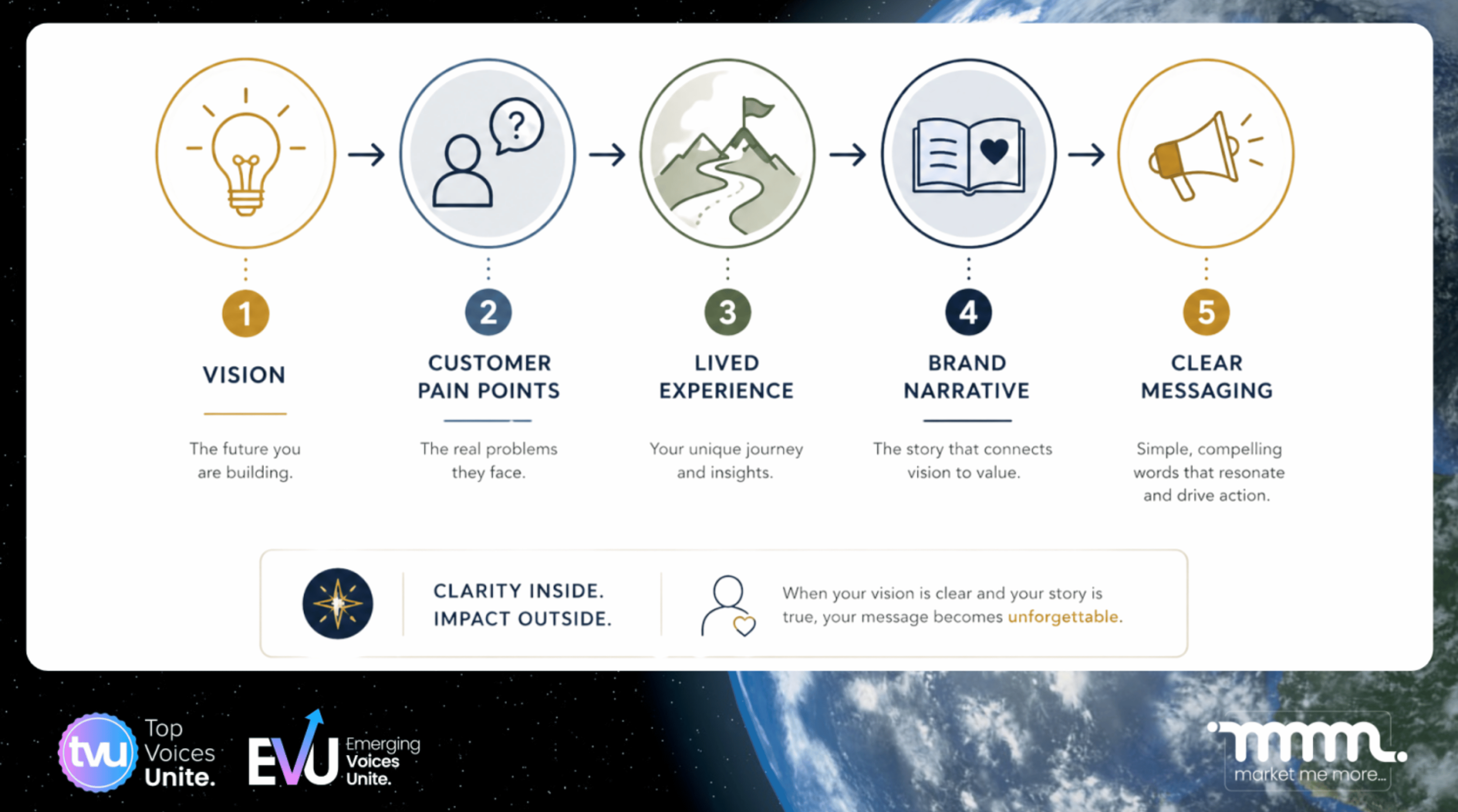
That is not a vision problem. For most founders and leaders, strategic storytelling is the missing piece, the skill that closes the gap between how clearly your vision lives inside you and how powerfully it lands for everyone else. Without it, even the strongest founder marketing strategy feels like shouting into silence. With it, your content, your pitch, and your brand narrative all start working together instead of competing for attention.
What is strategic storytelling for founders?
Strategic storytelling for founders is the practice of translating lived expertise and vision into a brand narrative that makes the right audience feel seen before they are ever sold to.
It is not about being a great writer, it is about knowing whose world your story needs to open in, and having the clarity to open it there every time.
The reason most founder content marketing is not working has nothing to do with frequency, format, or platform. It is because the story underneath the content is starting in the wrong place, with the founder's world instead of the customer's. And an audience that does not feel recognized in your first sentence will never stay for your offer.
How do founders scale their vision through marketing?
Founders scale their vision through marketing when they stop leading with what they have built and start leading with the problem their audience is already carrying.
When a founder's brand narrative opens in the customer's world, naming the tension, the frustration, the gap, it earns attention, builds trust, and scales naturally across every content channel and platform.
The "Vision-to-Voice" Habit
Why is my founder content not getting engagement?
Founder content fails to get engagement most often because it leads with the brand instead of the customer's problem.
When content opens with achievements, offers, or updates before making the audience feel understood. It gets skipped, not because the value is missing, but because the story started in the wrong room.
The Catch? It is genuinely hard to see your own story clearly when you are the one living it.
The founders who are closest to their vision are often the ones who struggle most to translate it, not for lack of effort, but because clarity from the inside looks completely different from clarity on the outside.
And if you are thinking "my vision is strong but it is just not translating", that is not a sign something is wrong.
It is a sign the story just needs the right voice to come through.
How do founders and leaders build a brand narrative that works?
A founder brand narrative that works starts with the customer's problem, moves through the founder's unique lived experience, and arrives at the solution with enough emotional truth that the audience already feels the answer before it is named.
Clarity, not volume, is what makes a brand narrative scale.
If your vision is ready but your story is still catching up, we would love to have that conversation with you. Reach out here or send a note directly to chenny@marketmemore.com.
Register for our weekly newsletter to learn more from our Voices community, industry experts who teach on technology, sustainability, leadership, and go-to-market strategies, and how these affect the future of work.
That wraps up this week’s coverage.
If you missed the room, the energy, or the conversations that mattered—you now have the highlights that count. We’ll continue documenting the ideas, voices, and moments shaping our community, so you never fall behind.
More sessions ahead. More insights to unpack.
We’ll see you in the next issue!


